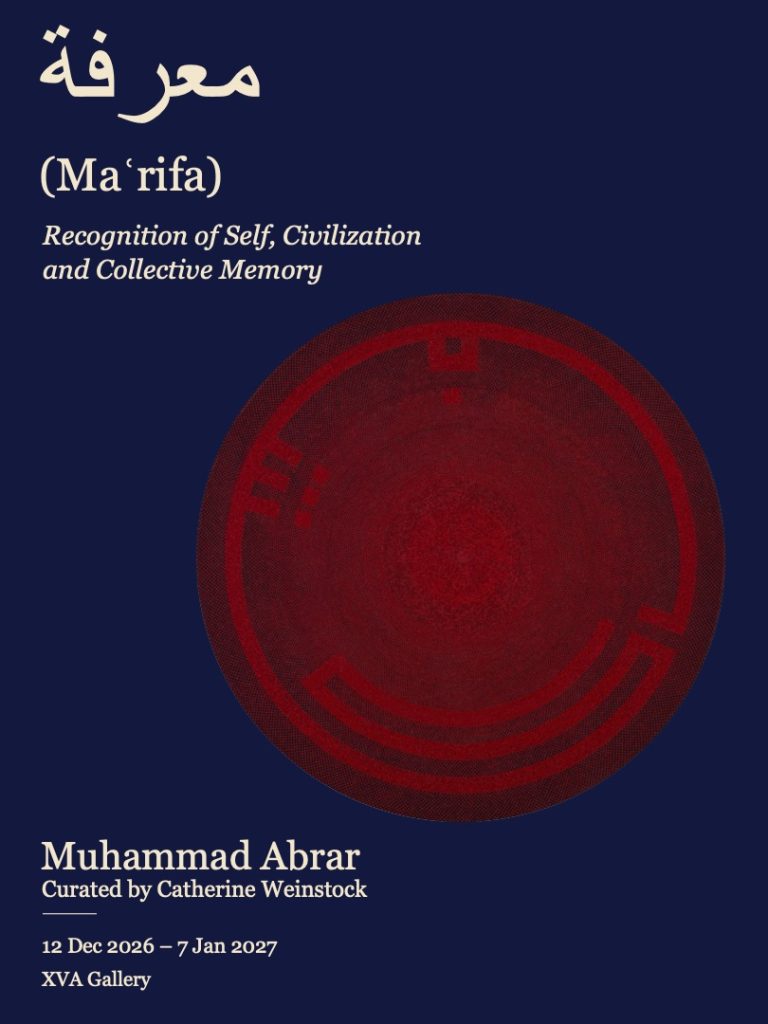
Maʿrifa (معرفة)
Artist Statement
This series takes its starting point from ideas, experiences and personalities encountered in classical Arabic texts, exploring their significance beyond the boundaries of a particular culture, language or geography. The title Ma’rifa, commonly understood as knowledge, recognition or a deeper form of knowing, carries particular significance within mystical thought, where it refers to a form of understanding that extends beyond intellectual knowledge into experience and contemplation. For this body of work, I am interested in Ma’rifa as a way of approaching the relationship between the self and the wider histories, experiences and traditions that shape our understanding of existence.
An important part of my research involved studying and visiting the water bodies of this region, particularly the Indus River and its tributaries. I was interested in how these waterways gave rise to entire civilizations and how they continue to carry traces of the histories that have unfolded along their courses. I began to consider rivers as witnesses to the passage of time, holding the memory of the lands and people they have sustained. In a similar way, I considered how an individual carries these traces and reflects an entire civilization within themselves. Water, in this sense, became a metaphor for memory and continuity, while the individual became a conduit through which this memory is carried and reflected.
The cultural and material heritage of the region also informed the visual language of the series. Ajrak, with its long history and significance in this part of the world, became an important reference, particularly through its characteristic palette of indigo, earthy brick red, black and white. Beyond its visual qualities, Ajrak carries cultural associations with the region’s traditions and spiritual practices, including Faqeeri and Sufism. Alongside this palette, some works explore black and white as contrasting elements, bringing together differences in a way that suggests harmony and balance.
Calligraphy, geometric patterns and the rhythmic arrangements of paper tesserae form the visual vocabulary of these works. I have explored the relationship between precision and freedom, structure and irregularity, allowing different patterns and rhythms to coexist within the compositions. The interplay of contrasting elements, whether through color, pattern or form, creates a sense of movement. The fluidity of calligraphic forms and the rhythm of these arrangements create a visual language that does not simply represent the literal meanings of written words, but also evokes a more universal understanding and experience of the ideas they convey.
Muhammad Abrar
Pakistan, November 2026
Curators Statement
As the curator of this exhibition, I invite you to explore the connection between personal identity, civilization, and collective memory. Muhammad Abrar’s work takes us on a journey of discovery, uncovering the layers of history, culture, and memory that shape who we are.
The exhibition’s title, Maʿrifa (معرفة), is an Arabic word meaning knowledge, recognition, or understanding. In Sufism, it also refers to a deeper spiritual awareness of oneself and the Divine. Through his work, Abrar explores how our identities are shaped not only by personal experiences but also by the traditions and memories passed down through generations.
Drawing inspiration from the Indus River, which has sustained civilizations for thousands of years, Abrar reminds us that the past remains part of the present. Just as the river carries traces of the lands through which it flows, we carry the memories and experiences of those who came before us.
His work reflects the rich cultural heritage of Sindh, drawing on Ajrak, the region’s traditional patterned textile, and the spiritual traditions of Sufism and Faqeeri. Through calligraphy, geometric patterns, and the familiar colors of indigo blue, earthy red, black, and white, he connects past and present, tradition and change, and individual and collective identity.
At the heart of Maʿrifa is the idea that to understand ourselves, we must also recognize the history, culture, and collective memories that have shaped us.
Ultimately, Abrar invites us to look beyond the words and patterns. We need not understand the language of his calligraphy to appreciate its beauty or meaning. Instead, the colors, shapes, and rhythms may awaken something familiar within us – a memory, an emotion, or a sense of belonging.
Through Maʿrifa, Abrar reminds us that true knowledge comes not simply from learning about the past, but from recognizing our connection to it.
Catherine Weinstock
New York, November 2026